Course Prerequisite(s)
- Please note that this course has the following prerequisites which must be completed before it can be accessed
-
 What is RAG?
About Course
Advanced RAG Course: Retrieval, Reasoning and Reliable AI Systems
Move beyond the definition of Retrieval Augmented Generation and learn to evaluate how RAG systems use evidence. This advanced conceptual course from NORAI Academy examines the decisions behind reliable retrieval, context preparation, grounded answers and responsible operation.
The October 2026 edition contains forty original text lessons, practical source packets and eight automatically marked assessments. It is designed for learners who understand the fundamentals and want to judge architectures, diagnose failures and explain which improvements are supported by evidence.
What you will study
- Requirements, answerability and the differences between correctness, groundedness and completeness.
- Source authority, document structure, contextual retrieval and knowledge maintenance.
- Keyword, vector and hybrid search, filtering, query planning and reranking.
- Context selection, conflicting evidence, citation support and appropriate uncertainty.
- Agentic retrieval, structured data tools, GraphRAG, multimodal evidence and memory.
- Evaluation sets, precision, recall, ranking and the limits of automated judges.
- Permission boundaries, prompt injection, poisoned sources and data handling.
- Cost, latency, caching, model changes and operational decisions.
Understanding before implementation
This is not a coding tutorial. You will interpret documents, search results, answer traces and performance reports rather than install frameworks or submit a software project.
Examples and assessment datasets are fictional unless explicitly identified as published research. Their numbers are teaching inputs, not claims about a commercial product or universal performance benchmarks.
Assessments
Each section ends with an assessment. Questions use fixed answer keys and require no instructor marking, essay submission or AI grading service. The final section includes a case assessment that draws together the whole course. A minimum score of 80% is required in each assessment, with unlimited attempts and no time limit.
Who should take this course?
The course suits professionals, product owners, consultants, business leaders and technical learners who want a deeper conceptual understanding of RAG. Complete NORAI Academy’s What is RAG? course first.
By the end, you should be able to inspect a RAG application’s evidence and outputs, locate likely failure points and justify a next investigation or improvement. Completion demonstrates study of these concepts, not independent verification of production engineering competence.
Course Content
Evidence, requirements and failure diagnosis
-
Define what a successful answer must achieve
-
Correctness, groundedness and completeness
-
Different questions need different evidence
-
Trace failures through the system
-
Choose the approach that fits the task
-
Assessment 1: Evidence and diagnosis
Knowledge preparation and preserving meaning
Retrieval strategy and query planning
Context engineering and grounded answers
Advanced RAG architectures
Evaluation and interpreting results
Security, permissions and trust boundaries
Performance, maintenance and the final case
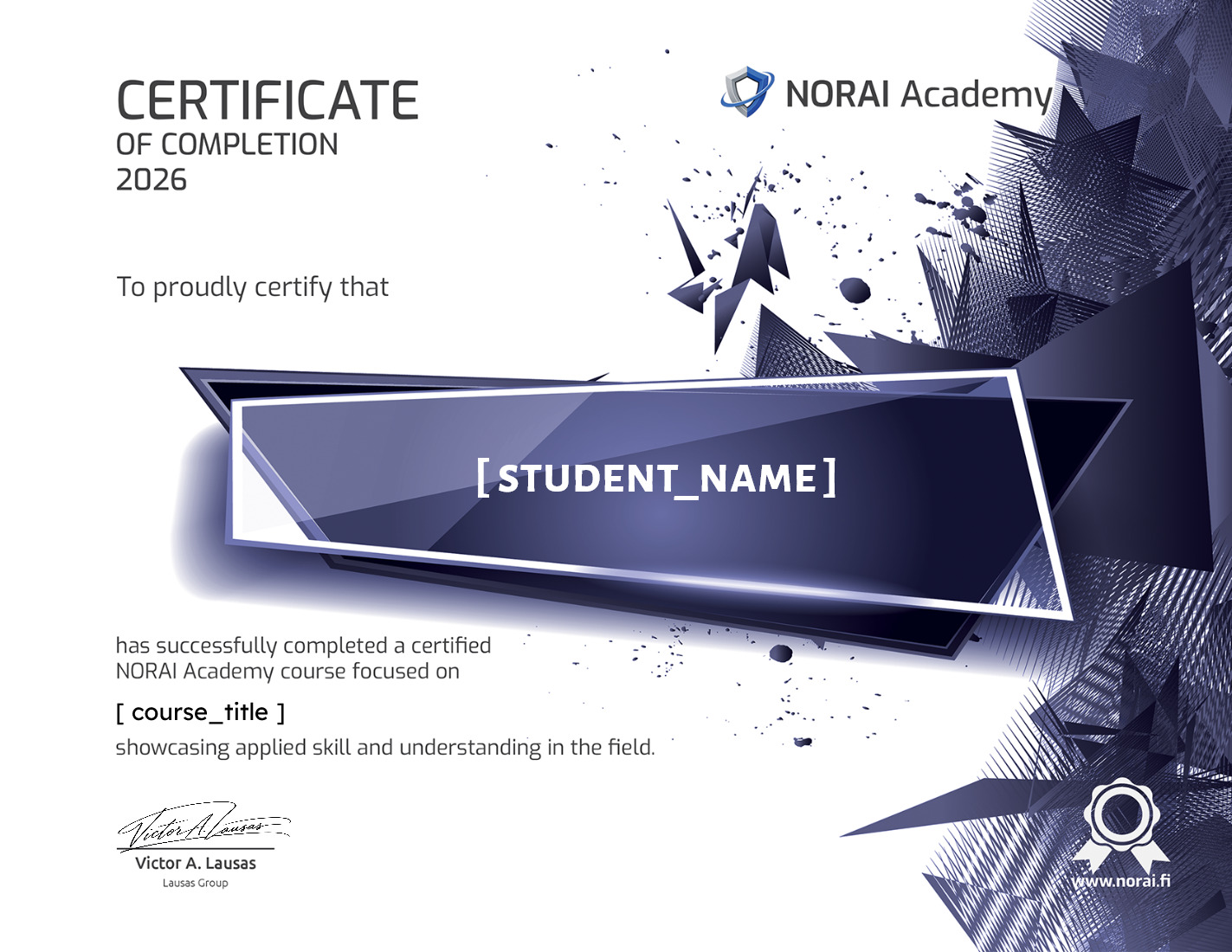
Earn a FREE certificate on completion!
Add this certificate to your resume to demonstrate your skills & increase your chances of getting noticed.
Student Ratings & Reviews