Course Prerequisite(s)
- Please note that this course has the following prerequisites which must be completed before it can be accessed
-
 Prompt Engineering Mastery: From Foundations to Future
-
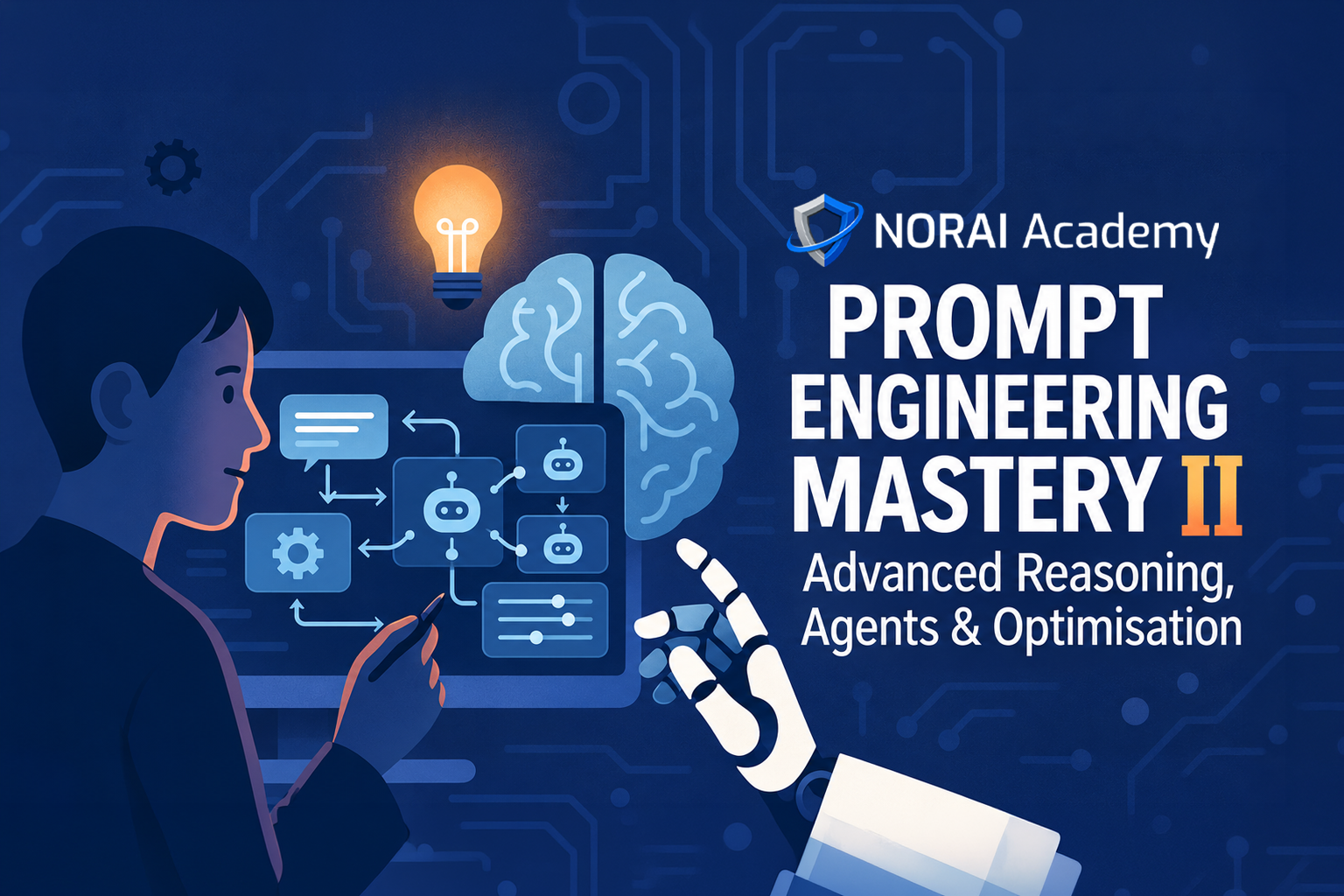 Prompt Engineering Mastery II: Advanced Reasoning, Agents and Prompt Optimisation
About Course
Context Engineering: Beyond Prompt Engineering
A clear prompt is only part of a reliable AI workflow. The system also needs the right information, in the right form, at the right moment, with appropriate permissions and a way to verify what happened.
This advanced conceptual course from NORAI Academy teaches you to inspect those decisions. Through 70 text lessons across 14 sections, you will examine context selection, evidence, memory, tools, agent workflows, security and evaluation in plain English.
Understand the whole workflow
Follow Kajo, a fictional professional services assistant, through a series of independent, fully specified cases. Reconstruct what was available, what reached the model, what the system was permitted to do and what actually changed. Then apply the same principles to unfamiliar research and software operations cases.
- Define task contracts, acceptance conditions and authority boundaries.
- Preserve meaning through tables, visual evidence, extraction and summaries.
- Select complete context under explicit resource limits.
- Distinguish tool requests, uncertain outcomes and verified effects.
- Review memory updates, compaction and continuity across sessions.
- Compare workflows, delegation, handoffs and concurrent state changes.
- Recognise prompt injection, poisoned information and unsafe cross boundary reuse.
- Interpret experiments, references, reliability and evaluation leakage.
- Assess cost, latency, release tradeoffs and recovery evidence.
Learn through worked decisions
Every section includes a worked dossier studio and a glossary. Eight reusable tools help you organise evidence, calculate context budgets, review memory changes, verify operations and prepare a design review. Private practice is unsubmitted and includes worked explanations.
Automatically marked assessments
Fourteen section quizzes and a separate final assessment contain 164 questions with fixed answer keys. You will select supported conclusions, interpret traces, compare packets and perform simple calculations. No essay submission, instructor marking or AI grading service is required.
The pass requirement is at least 80% in every assessment: 8 of 10 in each section and 20 of 24 in the final. Attempts are unlimited and there is no time limit.
Who this course is for
This course suits professionals, consultants, product owners and technical learners who already understand basic prompting and LLM concepts. Prompt Engineering Mastery or equivalent knowledge and a foundation in RAG are recommended. You do not need programming experience, a paid AI subscription or access to production infrastructure.
Research informed and carefully bounded
The October 2026 edition includes optional primary research and official technical readings. The lessons explain the assessed concepts, and all necessary case facts are supplied. Fictional policies, measurements and organisations are teaching inputs, not promises about commercial systems.
By the end, you should be able to review a context design, distinguish demonstrated failures from untested explanations and justify the next investigation or improvement. Passing fixed case assessments does not independently certify production implementation competence or provide university credit.
Course Content
From prompts to observable context
-
1.1 The model sees a packet, not your whole world
-
1.2 Instructions, evidence, state and capability
-
1.3 The context lifecycle
-
1.4 Read an observable trace
-
1.5 A baseline before architecture
-
Section 1 assessment: Reconstruct the invocation
Task contracts and authority
Representations that preserve meaning
Context selection under constraints
Evidence acquisition beyond a document dump
Tools, observations and consequential actions
Memory as a governed change process
Long tasks, compaction and continuity
Workflow control and bounded autonomy
Coordination, handoffs and shared state
Security across context boundaries
Experiments, evaluation and causal diagnosis
Operating tradeoffs and change assurance
The context design review
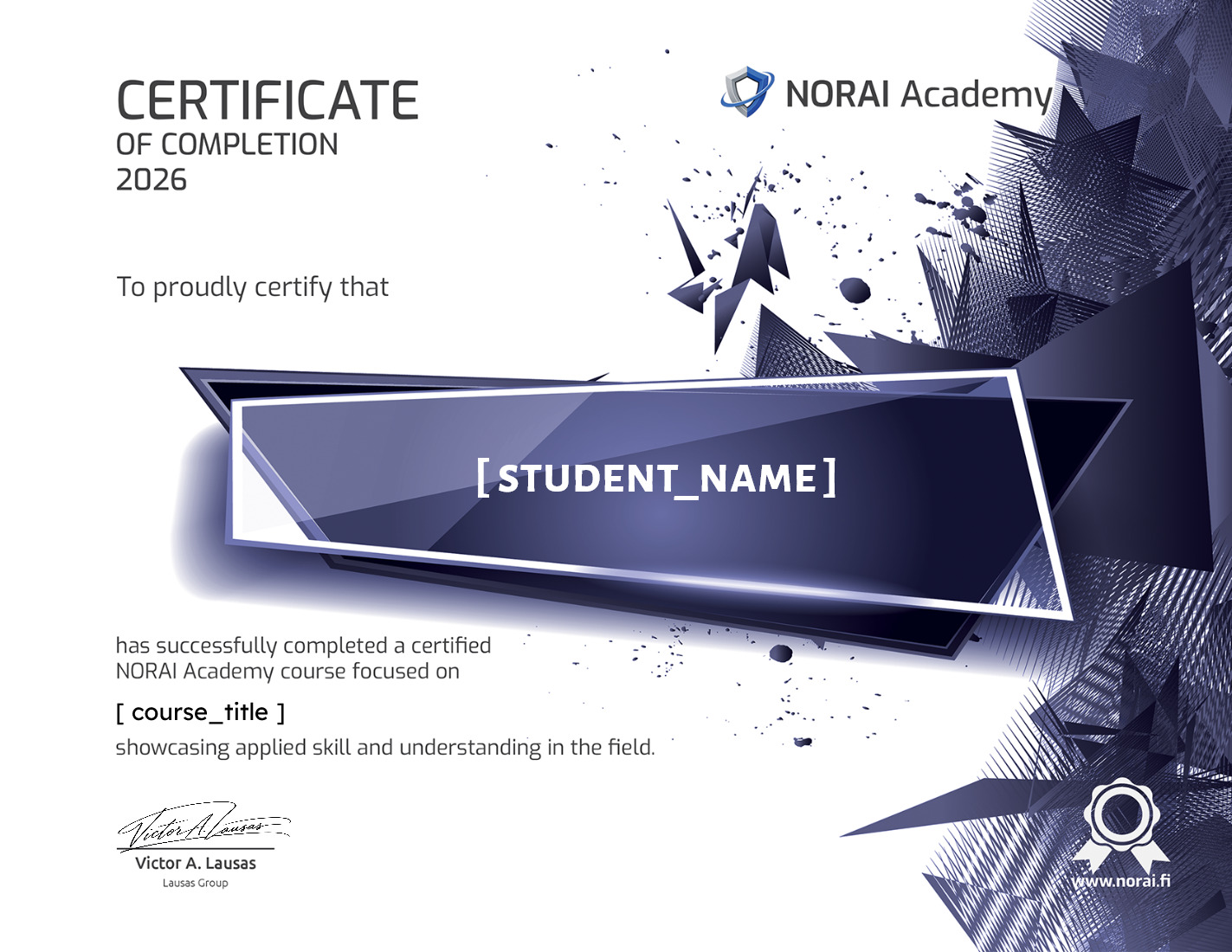
Earn a FREE certificate on completion!
Add this certificate to your resume to demonstrate your skills & increase your chances of getting noticed.
Student Ratings & Reviews