Course Prerequisite(s)
- Please note that this course has the following prerequisites which must be completed before it can be accessed
-
 Prompt Engineering Mastery: From Foundations to Future
About Course
Prompt Engineering Mastery II: Advanced Reasoning, Agents and Prompt Optimisation
You know how to write an effective prompt. Now learn how to design the programme around it: how it reasons, searches, uses examples, calls tools, improves from feedback and produces work across different media.
This free advanced prompt engineering course from NORAI Academy is the continuation of Prompt Engineering Mastery: From Foundations to Future, not a replacement for it. Complete the original course first. Named refresher references connect familiar concepts to the new mechanisms without repeating the full introductory lessons.
Go beyond a single prompt
Across 80 text lessons in 16 sections, you will study advanced reasoning and test-time compute, demonstration engineering, self-consistency, best-of-N, Tree of Thoughts, adaptive workflows and automatic prompt optimisation. Worked traces explain DSPy, MIPROv2, SIMBA and GEPA in plain English.
You will also examine tool-using agents, multi-agent cooperation, MCP and A2A concepts, evidence-led research, multimodal investigation, creative production, prompt caching, model transfer and deployment economics. Research clinics connect established methods and recent papers to decisions you can actually analyse.
Advanced depth, clear explanations
Follow Atlas, a fictional research-and-communication workbench, through contrasting designs. Inspect the inputs, intermediate records, observations, costs and checks. Then transfer those ideas to unfamiliar final-assessment organisations. Every assessed task includes its necessary facts; synthetic case results are teaching fixtures, not live model benchmarks.
Build a private mastery workbench
Sixteen worked studios and embedded worksheets help you develop task contracts, instruction stacks, demonstration policies, reasoning ledgers, search controllers, optimisation plans, agent policies, evidence matrices and a complete architecture dossier. Private practice is unsubmitted and includes worked comparisons.
Automatically marked assessments
Sixteen section checkpoints and a separate final challenge contain 192 fixed-key questions. Analyse traces, calculate stipulated costs, compare designs and choose supported conclusions. No essays, uploaded projects, instructor marking or AI grading service are required.
Pass each section at 8 of 10 and the final at 26 of 32. Attempts are unlimited and there is no time limit. Worked feedback explains every option. No paid AI subscription, live API calls or coding are needed to complete the course.
A connected three-course pathway
Start with Prompt Engineering Mastery: From Foundations to Future. Continue here with advanced prompt programmes. Context Engineering: Beyond Prompt Engineering is the next learning step for information selection, memory, state and the context lifecycle across whole workflows.
Passing the supplied analytical cases demonstrates performance on those cases. It does not independently certify production deployment competence, professional licensing or university credit.
Course Content
The modern prompt engineering workbench
-
1.1 From a single prompt to a prompt programme
-
1.2 The design levers: instructions, context, compute and weights
-
1.3 A task contract strong enough for advanced work
-
1.4 Read outputs and experiments like an engineer
-
1.5 Studio: specify the Atlas workbench
-
Section 1 checkpoint: The modern prompt engineering workbench
Instruction architecture and structured control
Advanced in-context learning and demonstration engineering
Modern reasoning strategies and inference-time compute
Inference-time search, ensembles and verification
Adaptive prompting and workflow control
Automatic prompt optimisation
DSPy, joint optimisation and GEPA
Agentic prompt design and tool use
Multi-agent cooperation, critique and interoperability
Research synthesis and evidence-intensive prompting
Multimodal reasoning across images, audio and video
Creative direction and multimodal production
Prompt performance, economics and cross-model transfer
Evaluation, robustness and the research frontier
Integrated professional mastery
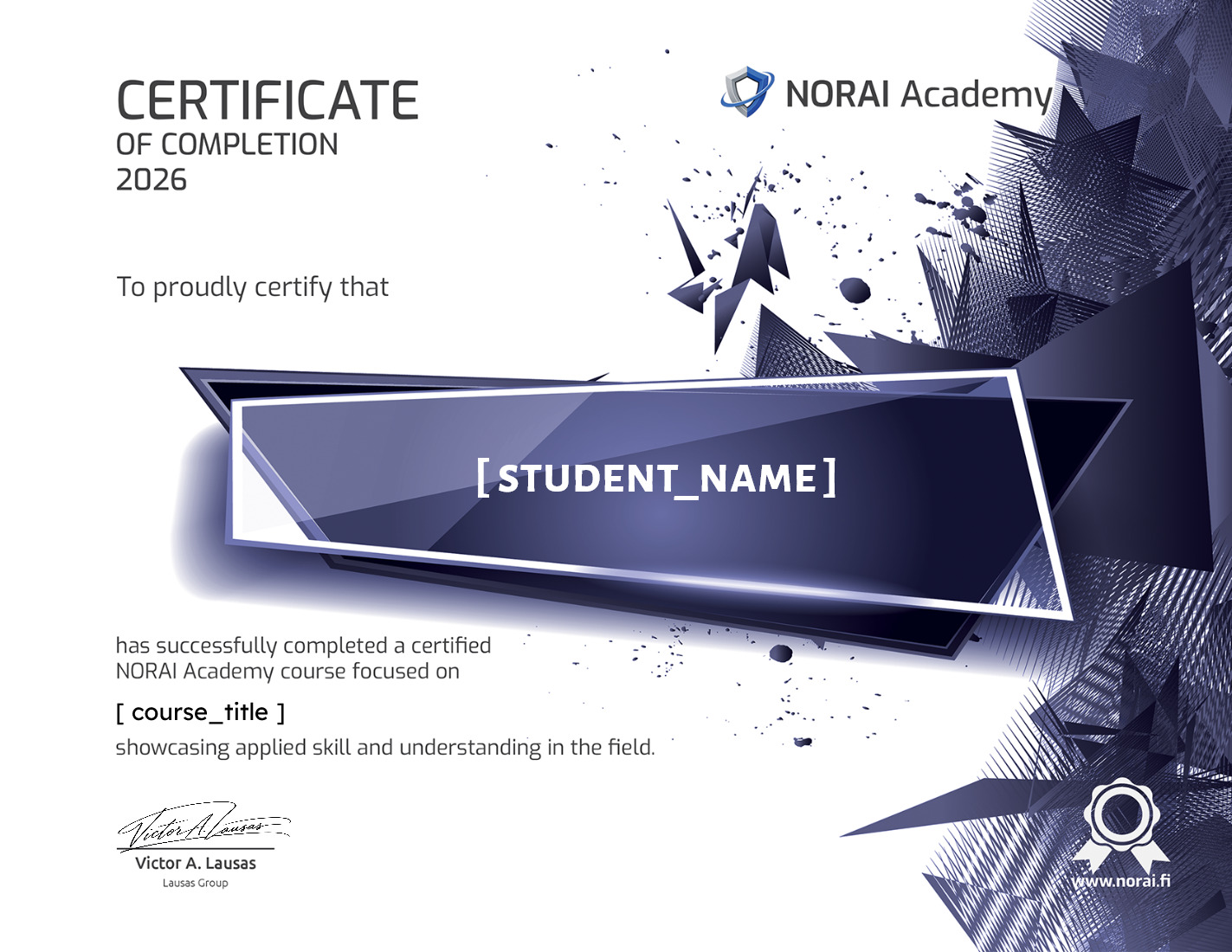
Earn a FREE certificate on completion!
Add this certificate to your resume to demonstrate your skills & increase your chances of getting noticed.
Student Ratings & Reviews